

From idea to legacy: Campbell Law School turns 50
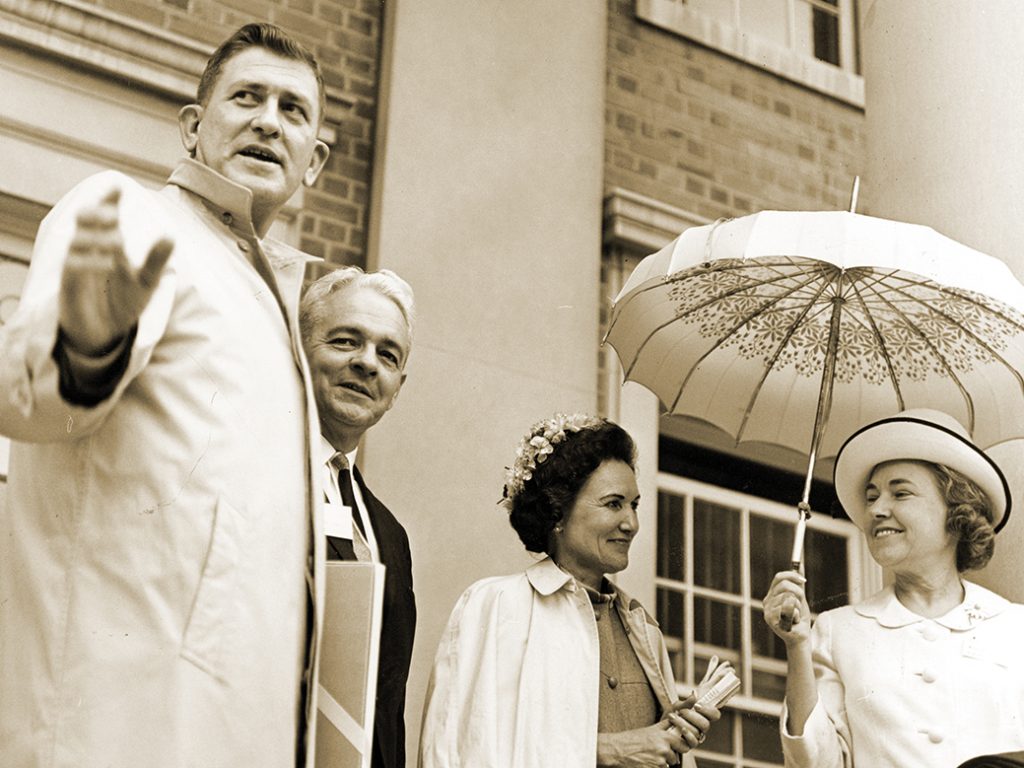

The Norman A. Wiggins School of Law celebrated its 50th anniversary with a black tie Gala in downtown Raleigh on Sept. 17. Below is a brief history of the founding of the law school by President Wiggins in the mid 1970s and the legacy the school has built in its half-century of producing quality attorneys, judges and other legal professionals in North Carolina and beyond.
THE IDEA:
A few years into his presidency at Campbell College, Norman Wiggins got asked one question more often than others: “When are you starting a law school?”
Wiggins earned his law degree at Wake Forest University and taught there before joining Campbell in 1967. He and Campbell’s trustees and presidential advisors were concerned about the state of legal education. They saw recent law graduates who lacked ethics, who clustered to urban centers and who hadn’t been thoroughly trained. But it was only in 1963 that Campbell graduated its first four-year class after operating as a junior college for 35 years, Wiggins would say. “We are not ready right now.”
Campbell’s academics got a boost in 1972 when an accrediting agency visited. The school also began its first major fundraising campaign, leading to a stronger library, enhanced curriculum and improved physical space — all important for law school accreditation. The right time came in 1974. In October, Wiggins told the N.C. Baptist State Convention that Campbell planned to start a law school that emphasized “ethical, moral and Christian standards” and trained “people with the idea that a lawyer is a special kind of person, that he is doing more than just making money.”
THE CRITICISM:
Not everyone supported it. Several state newspapers and UNC System leaders spoke out in opposition. They pointed to a 1974 study by the Triangle Research Institute that concluded there was “no need for additional law schools in North Carolina,” because the state needed to produce only 200 lawyers a year between 1974 and 1984, though its four law schools were admitting 450 students each year.
Also, the leaders of peer institutions expressed concerns that funding allocated to their schools would be redirected to support Campbell’s law school at a time when their budgets were already strained. They urged Campbell to reconsider.
“If it hadn’t been for President Wiggins’ foresight and determination, that might have been the end of it,” says Olivia Weeks, an assistant professor and the library director at the Campbell Law School who is writing a history of the school.
THE NEED:
North Carolina needed Campbell’s proposed law school, because too many people in the state didn’t have access to quality legal service, Wiggins told his peers at a follow-up meeting with the N.C. Baptist State Convention in July 1975. According to a study by Harold Wren, the dean of the University of Richmond’s School of Law, seven of the 100 counties in North Carolina — 30 percent of the state’s population — had half of the state’s lawyers; the remaining 93 counties shared the other half. Some counties, like Pamlico, didn’t have a single lawyer.
“Experience has shown that lawyers are somewhat like doctors in that they tend to practice in cities and metropolitan areas,” Wiggins told the N.C. Baptist State Convention. Campbell’s graduates, however, tended “to settle in small towns.”
Campbell was also financially able to support a law school without additional funding from the convention, he added. The school had secured $500,000 in pledges and was beginning a five-year, $12 million fundraising campaign. The convention approved the law school.
THE DIFFERENCE:
Margaret Currin was among the first 97 law students who began studies at Campbell in August 1976. She was also just one of two non-Harvard students who completed a summer internship in a division of the U.S. Attorney’s Office following her second year. At first, she says, she was unsure how her Campbell education “would stack up against any other law school, let alone Harvard’s.” But the interns from the more established law schools were not familiar with some of the basic practical procedures that Campbell had taught its students.
“That impressed upon me the quality of the legal education I was getting,” says Currin, now a Campbell law professor.
When Leary Davis left his practice to become founding dean of Campbell’s law school, he saw an opportunity at Campbell “to do something different” with legal education, he says. Among the innovations: a rigorous curriculum that emphasized practical education. Students were required to complete 10 hours of procedural courses, at least one planning course, and a trial and appellate advocacy program. “… Few law schools go as far as Campbell in requiring the experiential learning experiences that helps students learn to think, think critically, and solve problems,” says Davis, today retired.
When Currin and the law school’s first class graduated in 1979, nearly every one of them passed the bar exam. It wasn’t beginner’s luck. Campbell’s overall record of success on the N.C. Bar Exam has been unsurpassed by any other law school in the state for the past 26 years.
THE LEGACY:
The law school was renamed in honor of Wiggins in 1988. Twenty-one years later, it moved to downtown Raleigh, where its externship program has flourished. Any given semester, 60 to 70 students complete externships, further strengthening Campbell’s experiential learning opportunities. The law school would eventually move into the top tier among law schools and collected its highest ranking ever.
Over the past five decades, Campbell Law has flourished. It is now the second‑largest law school in North Carolina, with graduates excelling statewide and nationally. The school has earned national and international recognition for advocacy, professionalism and innovative training; achieved a historic 100% bar passage rate in 1994; and expanded experiential learning through its now seven pro bono clinics, which serve the local community and beyond.
“Dean Emerita Melissa Essary’s bold 2006 decision to move the school to Raleigh transformed its trajectory, and we have continued to embed Campbell Law in the state’s legal and governmental center ever since,” current Dean J. Rich Leonard said at the 50th anniversary Gala held in September.