

Campbell Law 50th Anniversary Spotlight: Rashad Hauter ’11
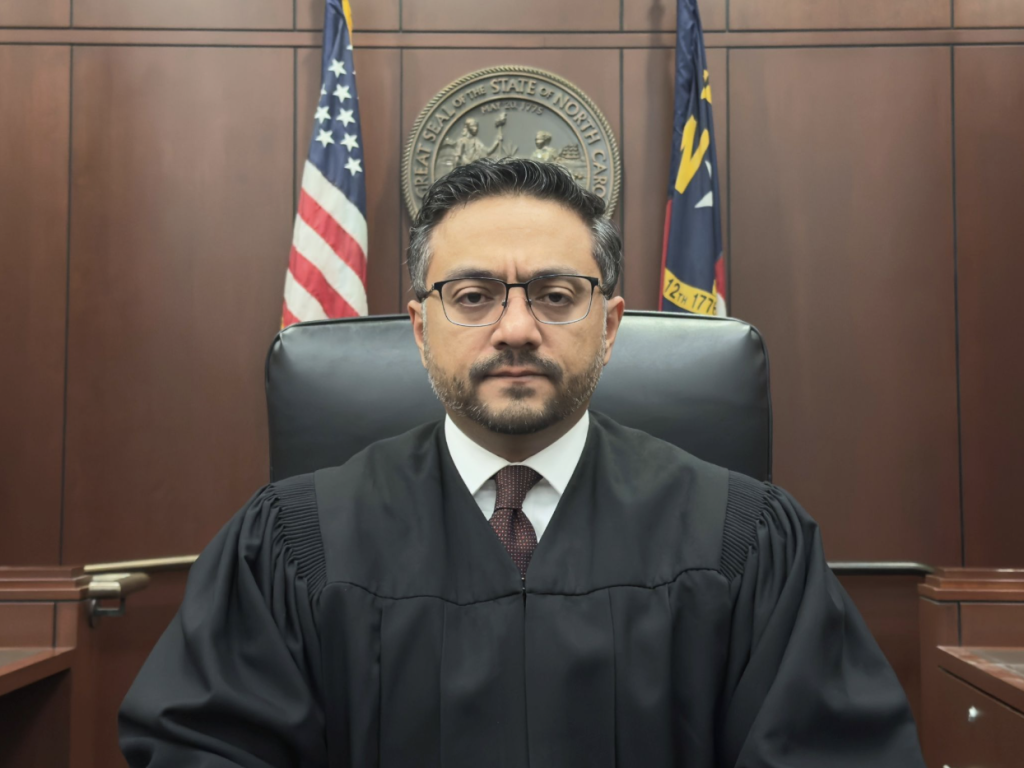

The Honorable Rashad Ahmed Hauter ‘11 made history in 2021 by being appointed a district court judge in the Wake County Judicial District Court making him the first Yemeni American to become a judge in the United States. He was re-elected to his seat on Nov. 3, 2026. He previously worked as a criminal defense and immigration attorney in private practice. Hauter is a first-generation immigrant, whose family moved to the U.S. from the remote village of Gatham, Yemen, fleeing poverty and unrest. Hauter grew up working in his family’s small business in Vance County, North Carolina, where he later graduated valedictorian from Southern Vance High School. He was first in his family to graduate from college, earning his bachelor’s degree in biology and Asian Studies with a concentration in Arabic from the University of North Carolina at Chapel Hill in 2007 and graduating cum laude from Campbell Law.
Current role: Wake County District Court Judge
Why Campbell Law?
What brought me to Campbell Law was the school’s emphasis on the practice of law as a higher calling to serve others. That really resonated with me because I have always believed that we are called by God to use whatever talents and opportunities we are given to serve others. For me, becoming a lawyer was never simply about earning a degree or building a career. It was about finding a way to serve people, seek justice and hopefully leave a positive impact on my community. That sense of calling has followed me through my career, from serving as a prosecutor, to representing individuals in private practice, and ultimately serving on the bench. The roles have changed, but the purpose has remained the same. To serve others faithfully and to remember that the law is ultimately about people.
On practice
My career has largely centered around the courtroom and public service. I began as a prosecutor, where I handled criminal cases from traffic offenses to homicides. I later entered private practice, representing individuals in criminal and immigration matters. Today, as a District Court Judge, my “practice area” is much broader. I preside over criminal, civil, family and special proceedings matters that affect people in very real and personal ways. What drew me to this work was the opportunity to help people and to have a direct impact on my community. The courtroom is often where people find themselves during some of the most difficult and consequential moments of their lives. Whether I was advocating for the State, representing an individual or now serving as a judge, I have always been drawn to the human side of the law. Serving on the bench has brought those experiences together. It gives me the opportunity each day to listen, apply the law fairly and ensure that every person who enters the courtroom feels that they were heard and treated with dignity and respect.
A lesson that stuck
One lesson Campbell Law taught me that I still carry with me is that being prepared in one of the most important ways we serve others. Campbell emphasized not only knowing the law, but being ready to practice it and understanding the responsibility that comes when someone places their trust in you. That lesson has stayed with me throughout my career. Preparation matters because the decisions made in a courtroom have real consequences for real people. What may be another case on a calendar to those of us who work in the courthouse may be one of the most important days in someone else’s life. Campbell Law taught me to never lose sight of that. Do the work, know the law, be prepared and treat every person and every case as deserving of your full attention.
The people who shaped him
Two professors who shaped the way I think about the law were Professor Richard Lord who taught Contracts and Professor Anthony Baker who taught Criminal Law. Professor Lord was tough and intensely focused on the technical aspects of the law. He taught us the importance of precision, careful analysis and understanding not just what the law says, but how and why the rules operate the way they do. Professor Baker challenged us to think about the human side of the law. Criminal Law was not simply a collection of statutes, cases and legal principles. He taught us to consider how the law develops, how it reflects the values of society, and how it affects real people. The lessons I took from each of them complement each other. The law demands technical precision, but it also requires an understanding of the people and society it serves. That balance has shaped me as a lawyer and continues to shape me as a judge.
On being Campbell Law family
Being part of the Campbell Law family means being part of a community that extends well beyond the years you spend in law school. It is a community that supports one another, celebrates each other’s successes and carries forward the values that bind generations of Campbell lawyers together.
Advice to current students
Learn the law, develop good habits and prepare yourself to be an excellent lawyer, but also take time to build relationships and remember why you came to law school in the first place.
The next 50 years
The next 50 years at Campbell Law should be defined by preserving the values that have made the school special while preparing students for a legal profession that will continue to change.
Sidebar
Currently listening to: Cat Stevens “Wild World”
Most adventurous thing: Running for office.
Favorite Raleigh spot: Legislative Building Cafeteria
Proudest moment: Swearing in my son, Akram Hauter ‘25, who is also a Campbell Law graduate.