

Engineering dean presents at Notre Dame’s Virtues and Vocations Conference
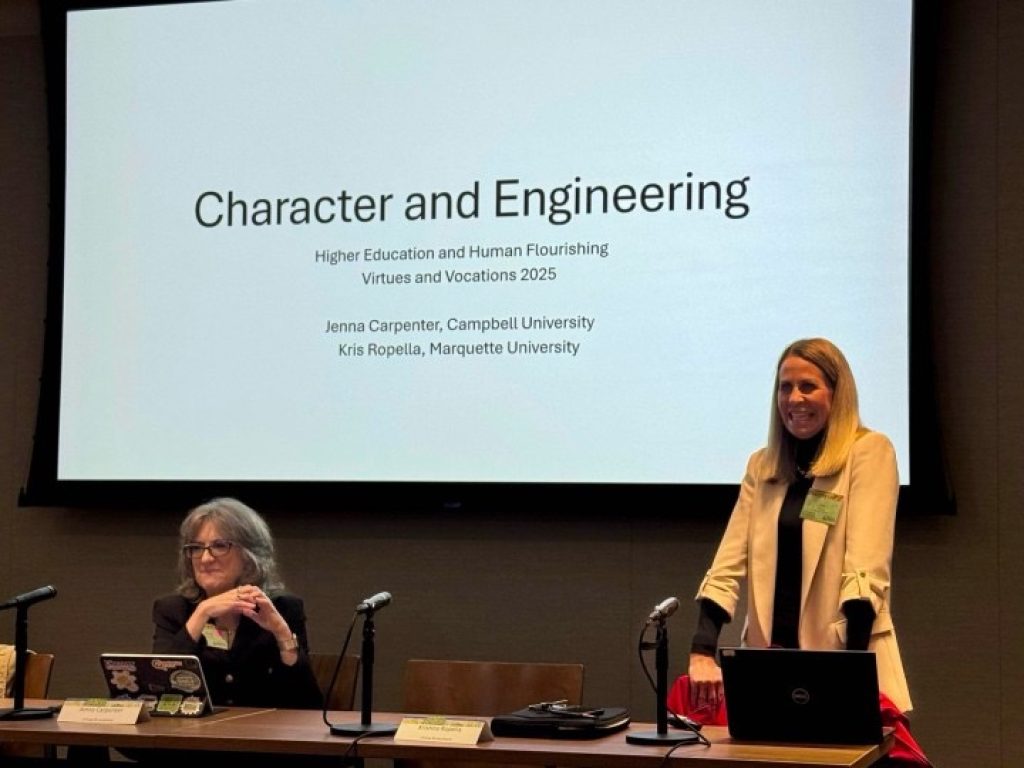

At Campbell University, Character, Initiative, and Calling are at the heart of all we do. We proudly recognize faculty and staff who embody the Hallmarks and contribute to our mission of preparing students for purposeful lives and meaningful service. In this article, Dr. Carpenter reflects on her experience attending and presenting at Notre Dame’s Virtues & Vocations Conference, where she shared her work building Campbell’s School of Engineering and their eight values.
Dr. Jenna Carpenter
I came to Campbell ten years ago with a vision of building an innovative 21st century Engineering School that welcomed a wide spectrum of students. I also wanted to build a program that graduated industry-ready engineers, so we didn’t want students to spend the bulk of their time in large lecture classes focused solely on theory and rote problem solving. So our inaugural group of engineering faculty and staff started planning our program by creating a mission and vision that clearly described these goals and that aligned with the university mission and vision. To help live out this mission and vision, so we also identified eight values (community, ethics, professionalism, service, resilience, relevance, ownership, and excellence) that encapsulate the type of culture and practices we hoped to create and then set about intentionally integrating these into our curricular and extracurricular activities.
Las summer, I was invited to attend the “Virtues and Vocations” Conference at University of Notre Dame, hosted by their Institute for Social Concerns, to talk about how Campbell Engineering infuses these values into our engineering curriculum to build character in our students. I talked about how relevance and resilience are embodied in our hands-on, project-based approach to engineering education, with classes taught in classlabs that combine lecture and lab, as well as support small, medium, and large individual and team-based projects in all of our engineering classes all four years. You see community reflected in our team-based approach which seeks to train students in the same type of environment they will find in the workplace. It also shows up in our collaborative and supportive approach to mentoring students that includes first year peer mentors and a first-year Living Learning Community, as well as peer tutors, small classes taught by real faculty who know their students in and out of class, and community-building activities like our wildly popular cardboard canoe race (that attracts alumni back to compete!), mystery night, and intramural engineering teams.
Our nationally award-winning competition teams for NASA and Future Cities provide students with additional experience developing community, resilience and relevant skill sets. First year students must complete a total of 50 hours of professional development and service outside of class (it’s a course requirement!), so we offer a wide range of opportunities, such as career fair and internship preparation, interaction with industry professionals, and workshops on topics like dining etiquette, professional dress, and specialized software tools. Our engineering students volunteer at open house and K12 outreach events like Engineering Day and K12 classes and groups (which feature team-based design projects that foster community, relevance, and resilience, just like our curriculum). They also hand-write notes of welcome for all new and prospective students. And it’s not just first-year students who engage in these professional development and service opportunities. These experiences instill an understanding of the value and obligation of professional development and service that motivates students to continue engaging in these opportunities not only during their four years here, but well after they graduate.
Ethics, professionalism and excellence are reinforced throughout the curriculum through design project requirements. Students also learn about the National Society of Professional Engineers (NSPE) Code of Ethics, participate in our NSPE Student Chapter activities, hear from members of the North Carolina state licensing board, study for and take the Fundamentals of Engineering (FE) Exam before graduation (the first-step to professional engineering licensure), and attend our Engineering Horror Stories Halloween event (which talks about famous engineering disasters and the moral and ethical failures that have under-pinned them). Ownership is a theme that we instill starting at summer orientation all the way through their senior capstone project. It includes showing up to class prepared, asking questions, completing your assignments on time, managing your time, motivating yourself to study, staying organized so you don’t miss deadlines, and holding yourself to the higher standard of a “Campbell Engineer”. Lastly, all of the awards we give all four years – to both individual students and to team projects – recognize those which reflect our eight values. Our individual awards event each spring on St. Patrick’s Day (he is the patron saint of engineering!) is particularly inspirational since student awardees are often nominated by their peers who catch each other living out our values when we faculty and staff aren’t even around.
Since our values have been a core part of our program since the beginning, it was refreshing to attend the “Virtues and Vocations” Conference with faculty from other professional disciplines, such as medicine, business, law, theology, and philosophy who are focused on instilling character in their students and professions. And on our campus, the Campbell Hallmarks (Character, Initiative, and Calling) intertwine and support our engineering values. Initiative embodies ownership, professional development, and excellence. Calling echoes our focus on relevance, service and supportive community. Character is reflected in ethics and professionalism. I have always observed that a faith-based liberal arts institution is an ideal place to build an engineering school. Engineering is a service-discipline at heart. So character, service, community, calling, ownership and initiative, professionalism, relevance and resilience, and ethics are paramount in engineering, given the role engineers play in designing solutions for people that solve important problems and improve the quality of life. We are excited that our engineering majors will see these themes echoed all across our campus, as we all seek to graduate Campbell students with exemplary academic and professional skills, prepared for purposeful lives and meaningful service.