

Hannah Byrd Collins ’20: In the middle of crisis and care
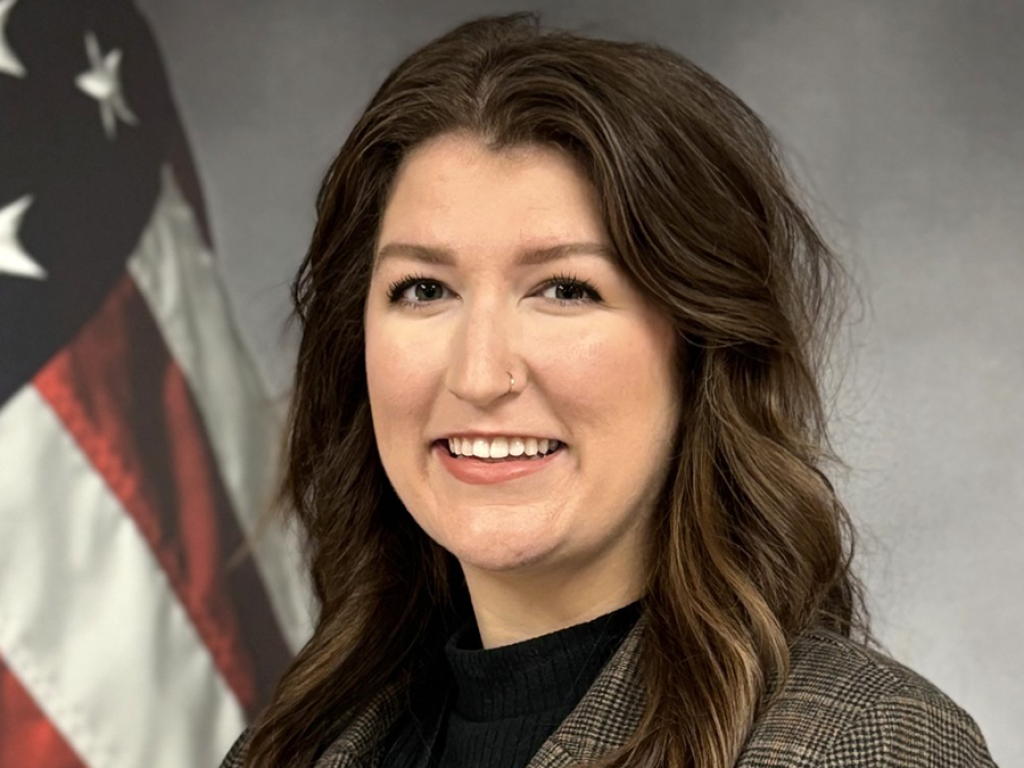

There is no typical day for Hannah Byrd Collins ’20.
As a human trafficking case manager for the Chesterfield County Police Department just outside Richmond, Virginia, Collins works with detectives and helps victims navigate investigations, court proceedings and the difficult process of rebuilding their lives.
Some days take her to court. Other days are spent developing policies or coordinating with community organizations. When law enforcement recovers a victim of human trafficking, Collins may be called to the scene to provide immediate support.
The foundation for that work began at Campbell University, where Collins earned bachelor’s degrees in psychology and social work and discovered a calling that combined her interest in human behavior with a desire to work directly with people.
That calling eventually led her on a career path she never expected.
“Never in a million years did I think that I would be in law enforcement,” Collins said. “But it’s the perfect marriage between social work and first responders in this specific position.”
Beyond the investigation
Collins works alongside six detectives on the department’s human trafficking team. While detectives focus on the criminal investigation, Collins focuses on the needs of the victim, providing social work support throughout the process.
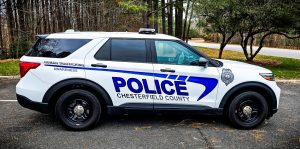
She maintains contact with victims throughout investigations and court proceedings, develops safety plans and connects individuals with substance use treatment, housing and other resources.
“These victims require a very holistic approach,” Collins said. “What I bring to the table is making sure a victim is heard and understood.”
This also means working with a wide network of agencies and organizations. Depending on the victim’s needs, Collins may coordinate help with Child Protective Services, Virginia State Police, the FBI, mental health providers, rehabilitation facilities or local shelters.
Progress looks different in every case, and success is not always easy to define. For one person, it could mean participating in an investigation and seeing a trafficker prosecuted. For another, it could mean entering recovery, finding stability or working toward regaining custody of their children.
Collins, however, measures success according to the goals of the person in front of her.
“I’ll take the little wins, I’ll take the big wins,” she shared. “Anytime that I can take a victim and help them become a survivor, help them embody that, that’s going to be a success for me, whatever that looks like.”
Where it started
Collins knew long before attending Campbell that she wanted a career helping victims and survivors of sexual violence.
The daughter of missionaries, Collins spent portions of her childhood overseas. Her family lived in Chiang Mai, Thailand for a year and later spent two years in Chile.
While living in Thailand as a young child, Collins remembers encountering aspects of the sex industry but not fully understanding what she was seeing.
Years later, she returned to Thailand when she was 16 on a mission trip. She worked with refugees and gained a new perspective on what she witnessed years earlier.
“I now had the language to pair with the experiences I’ve had, the things that I’ve seen,” Collins said. “That was an eye-opening experience for me. And I thought, I really want to do something about this.”
At first she pictured herself doing that through counseling. Psychology seemed like the natural path. Campbell, however, was not initially where she expected to pursue that path.
Choosing Campbell
Collins had plenty of reasons to choose Campbell. Her father, Tracy Byrd ’87, is a Campbell alumnus and client services manager in the University’s information technology department. Her sister, Sarah Byrd Waggett ’20, and brother-in-law, Jonathan Waggett ’14, also graduated from Campbell, along with several extended family members. Her grandmother worked at Campbell for about a decade.
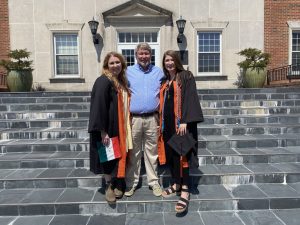
Despite her family’s long-running history with Campbell, it was not Collins’ first choice. Living in Virginia at the time, she planned on attending an in-state college with her friends. She only took a visit to tour Campbell as a courtesy to her parents. But while on her tour, she quickly learned that Buies Creek was the place for her.
“This feels so comfortable to me,” Collins remembers thinking. “I don’t have to fit myself into this school. This school will rally around me and help me be who I want to be.”
At Campbell, Collins initially studied psychology, drawn to the science and research behind human behavior. However, after an internship as a behavioral health technician working with children with autism, Collins learned that she wanted a more hands-on career.
“I like research, but I love being in the middle of something,” she said. “I love being kind of where everything is happening.”
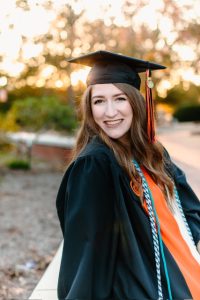
That realization led Collins to add social work as a second major. She completed bachelor’s degrees in both fields in 3½ years, gaining both an understanding of internal factors that shape behavior through psychology and the external factors surrounding individuals through social work. That combination continues to shape the way she approaches victims and the systems surrounding them today.
Finding the fit
Collins graduated from Campbell in 2020 and went on to enroll in the Master of Social Work program at the University of North Carolina at Chapel Hill.
She took an internship with WakeMed Raleigh, working in the emergency department to gain firsthand experience with crisis response. She also helped develop and evaluate a screening tool intended to identify patients who might be victims of human trafficking.
After earning her master’s degree, Collins joined InterAct of Wake County where she worked in a crisis center helping victims of domestic and sexual violence. She later moved to Virginia and spent roughly two years in hospital social work before seeing an opening with the Chesterfield County Police Department.
The position brought together the various parts of her professional journey: crisis response, direct work with victims and collaboration with first responders.
“I took my chance and they took a chance on me,” Collins said. “And here we are.”
Beyond the traditional path
Collins wants current students to understand that careers in social work can extend far beyond the settings they may first imagine.
Forensic social work can include roles in courts, correctional facilities, reentry programs and law enforcement agencies, career paths Collins knew little about when she was a student.
For students interested in pursuing a career in social work, Collins recommends pursuing internships along with other experiences that expose them to different professions and systems. She also encourages students to learn about substance use and recovery, an area she did not realize would play such a significant role in her career.
Collins stresses that understanding how government agencies, hospitals, non-profits and law enforcement work together can also prepare students for careers they may not know exist.
“Social work is all about systems,” she said. “It’s all about navigating systems.”
A human connection
Collins has learned that responding to a crisis requires knowledge and preparation, but also humility. She can’t enter every situation knowing exactly what will happen next.
What she can offer is the assurance that the person she is working with will not have to take the next step alone.
“We’ll figure it out,” Collins said. “We’ll take the next step together.”
For Collins, that willingness to meet someone in a moment of crisis and take the next step alongside them is what makes the work meaningful.
“That to me is such a human connection.”
—
Human Trafficking Resources
If you or someone you know may be experiencing human trafficking, the 24/7 National Human Trafficking Hotline is available at 1-888-373-7888.